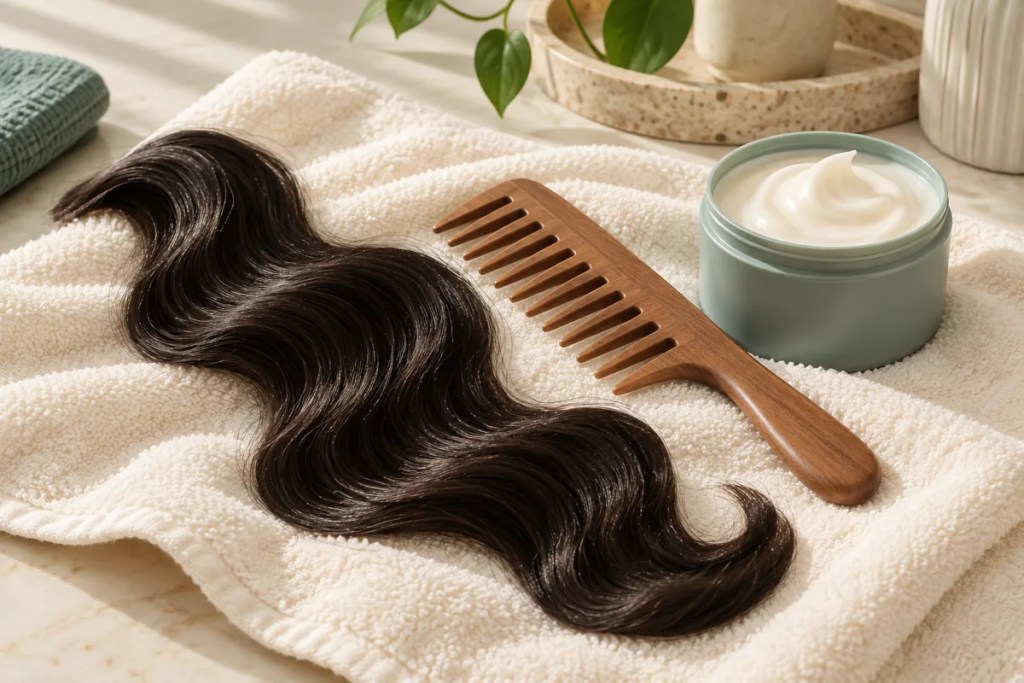
How to detangle hair depends partly on its texture: use gentle handling, manageable sections and an approach that lets you work from the ends upwards. Do not force a tool through a knot. A slower, comfortable session is more useful than finishing quickly by pulling.
This is a guide to caring for natural hair lengths, not a treatment for hair loss. Wigs and extensions can have different instructions, so follow their maker’s care guide rather than automatically using the same routine.
Choose the right timing for your hair
The American Academy of Dermatology’s healthy-hair advice distinguishes between textures. It recommends letting straight hair dry a little before combing, while thick, curly hair can be combed with conditioner still in place in the shower. It also advises using a wide-tooth comb for wet hair and starting at the ends.
That distinction explains why apparently contradictory tips may both make sense. “Never detangle wet hair” is not a useful rule for every texture. Equally, copying a curly-hair wash routine may not suit someone with fine, straight hair.
Prepare before the first pass
Read your conditioner or detangling product’s directions, including whether it should be rinsed out. Place your comb and clips within reach. Choose a position where you can work without rushing or holding an uncomfortable arm position for a long time.
Divide the hair into sections you can manage. The number is flexible: enough that you can identify the ends and work through a small area at a time. Keep completed sections separate so you do not repeatedly comb the same lengths.
How to detangle hair step by step
Begin at the ends
Work through the lowest part of a section before moving higher. Use short, gentle movements and stop when the tool meets resistance. This makes the process easier to control than beginning at the roots and pushing a collection of knots downwards.
Pause at a stubborn knot
Put the tool down if necessary and gently separate what you can with your fingers. Do not yank repeatedly or treat pain as part of the process. If the hair is severely matted or the area is painful, ask a suitably experienced professional for help.
Finish one section before moving on
Once a section is manageable, leave it alone while you complete the next one. There is no benefit in counting brush strokes or continuing long after the hair is detangled. Follow your product’s rinse or leave-in directions before styling.
Choose tools for the task
A wide-tooth comb is a useful starting point, but the condition of the tool matters too. Check for rough edges, broken teeth or buildup. A tool advertised for detangling still needs gentle use; the name does not make pulling harmless.
For curly or coily routines, a suitable conditioning step and sectioning may matter more than buying several similar brushes. For fine hair, a smaller amount of a product used correctly may feel preferable to layering multiple leave-ins. Let the label and your own handling experience guide you.
Make the next session easier to organise
Notice when tangles become difficult: after a windy journey, at the nape, or when several wash days are rushed. Adjust the practical setup rather than immediately adding a treatment. Keep tools clean and plan enough time for the parts that regularly knot.
If you use heat afterwards, see our heat-protectant guide. Detangling, conditioning and heat styling are separate decisions; one product does not automatically replace the others.
Frequently asked questions
Should I brush every hair type when dry?
No. Texture changes the appropriate timing. The AAD advice above is a better starting point than a single rule for all hair.
Will a detangling spray fix every knot?
No. Products vary, and some knots require patient handling or professional help. Do not keep adding product while increasing force.
What if I notice unusual shedding or scalp pain?
Stop the uncomfortable process and seek appropriate professional advice. Detangling advice cannot diagnose thinning, scalp conditions or the cause of shedding.
Can I follow this for a synthetic wig?
Use the wig’s own care instructions. Fibre type and construction can change the tools, products and timing that are suitable.
Explore the Etoraa beauty collection with your hair texture and routine in mind.
Sources and editorial note
AAD healthy-hair guidance linked above, updated 12 August 2024. Accessed 22 October 2026. This is supporting evergreen care guidance, not a new regrowth method or a product performance test.