
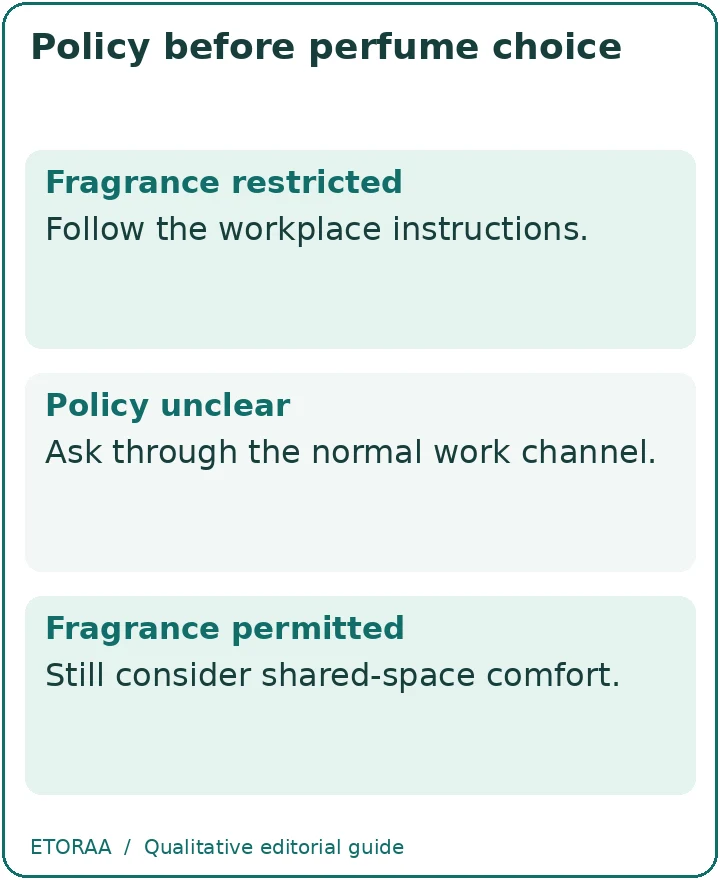
Perfume office etiquette begins with the workplace policy and the people sharing the space. If fragrance is restricted, follow that rule. Where it is allowed, a subtle-sounding note or a small bottle does not guarantee that others will find it comfortable. Choosing no added scent is always a practical option.
Etoraa editorial guide. General information, not a product test or clinical review. Featured visual: AI-generated illustration with generic props, not an Etoraa product photograph.
Perfume office etiquette starts with the setting
Check your employer’s policy before searching for an office-safe perfume. A fragrance-free environment can cover more than perfume: scented hair products, lotions and other personal products may also matter. Visitors should respect the same instructions when a workplace provides them.
The Canadian Centre for Occupational Health and Safety’s scent-free policy guidance discusses workplace approaches and affected product categories. It is general guidance, not a statement of every country’s law or your employer’s actual policy. Ask through the normal workplace channel if the policy is unclear.
Do not label a note universally safe
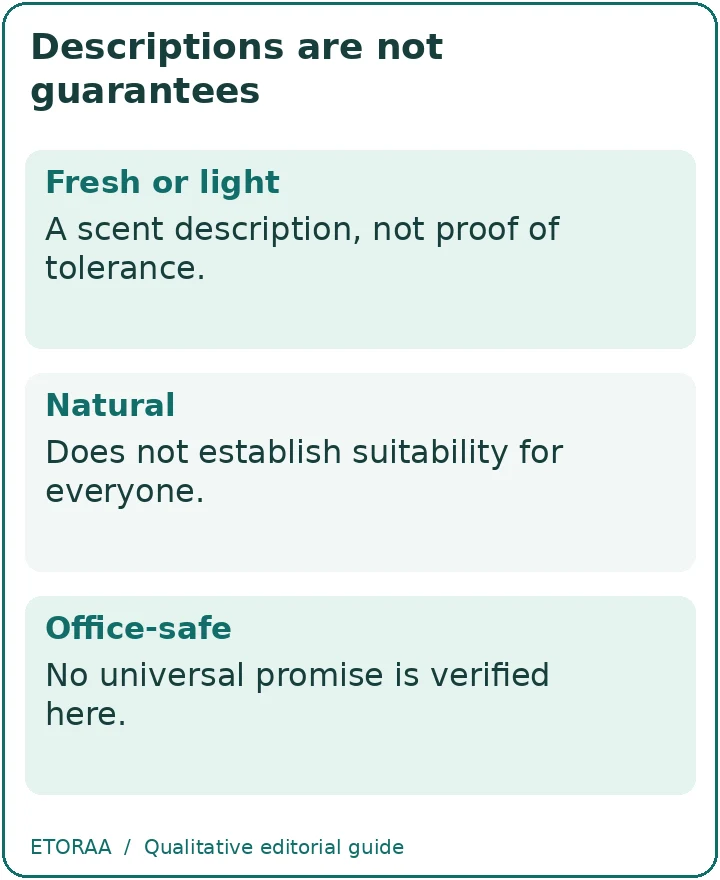
Fresh, natural, citrus, clean and light are descriptions, not guarantees of tolerance. A scent you enjoy can still be uncomfortable for somebody nearby. Do not assume that a colleague’s silence is approval or that a higher-priced formula will be more considerate.
Likewise, avoid gender rules about who should wear woods or florals at work. The useful question is the shared setting, not whether the fragrance matches a stereotype. A quiet preference for perfume can be enjoyed outside work when the office is the wrong environment for it.
Keep application out of communal spaces
If workplace rules permit scent and you choose to wear it, apply according to the product directions away from shared areas. Do not spray at a desk, in a lift or in a meeting room. Avoid turning an office bathroom into a place for testing several samples.
There is no universal spray count that controls every formula, atomizer, room or individual response. Do not reapply simply because you stop noticing your own scent. Our fragrance sampling guide is a better setting for deliberate testing on a non-work day, without treating a perfume note list as a workplace permission slip.

Respond usefully when somebody is uncomfortable
If someone raises a concern, listen and stop adding scent. Follow the workplace process rather than asking them to prove a personal health issue to you. Keep any private details private. The practical goal is a workable shared environment, not winning a debate about which perfume is objectively pleasant.
For example, you can reserve your preferred fragrance for after work and use familiar unscented choices where suitable. Our fragrance-free and unscented comparison explains why front-label wording needs careful reading. Browse fragrance for personal enjoyment with the setting in mind, rather than seeking a bottle guaranteed to suit every office.

Common questions
Is one spray always acceptable?
No. Follow the policy first. Concentration, application and the shared setting vary, so a number cannot guarantee that a scent will not bother someone.
Are natural scents automatically gentler?
No universal tolerance claim follows from that word. Do not use natural as a reason to ignore a workplace request.
What if I love perfume but the office restricts it?
Enjoy it at another suitable time and follow the workplace rule. That keeps personal enjoyment separate from a shared-space decision.
Sources and context
CCOHS: scent-free workplace guidance and the linked sources above were accessed on 26 October 2026. This is an evergreen practical guide informed by current seasonal beauty conversations, not a claim of rising search volume, new research or measured product superiority.