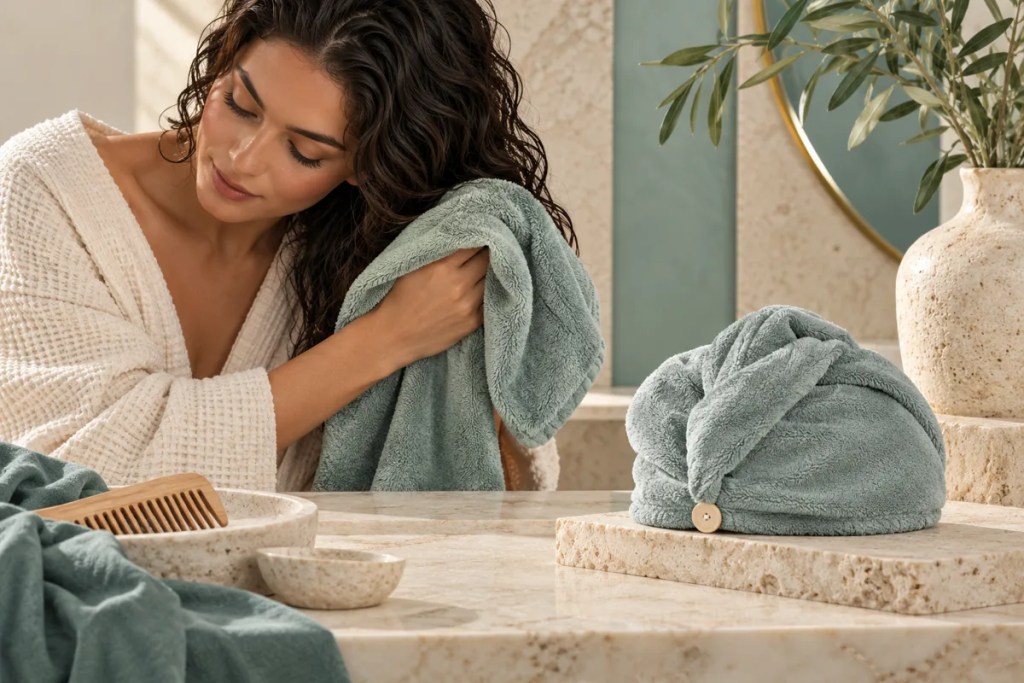
Towel drying hair can be a gentle water-removal step rather than a vigorous rub. Squeeze or blot carefully, avoid twisting a heavy wrap tightly and choose a method that works with your hair’s texture.
A specialist towel is optional. Changing the pressure and movement you use may be more useful than buying another accessory while keeping the same rough technique.
Why technique matters when towel drying hair
The AAD recommends absorbing water gently instead of rubbing hair with a towel. A towel should help manage excess water, not become a tool for scrubbing the lengths.
Think about the movements you make after rinsing. Are you dragging a towel repeatedly along the hair, twisting it hard or pulling at the hairline? Those are useful habits to notice before choosing a new fabric.
The aim is a comfortable routine with less unnecessary handling. It is not a promise that changing your towel will reverse damage, stop shedding or transform your hair’s growth.
A practical sequence after rinsing
Let excess water drain, then gently squeeze sections if that is comfortable for your texture. Use a clean absorbent towel to blot or wrap without a tight twist.
Keep the wrap light enough that it does not pull. If it feels heavy or tugs when you move your head, adjust it or remove it. You do not need to leave it on until every strand feels dry.
For curls, preserve the shape you want by limiting repeated handling. For straighter lengths, avoid vigorous rubbing that creates extra tangles. Your styling instructions may recommend a particular dampness before applying products.
Choose a fabric you can maintain
A soft T-shirt or suitable towel may be enough. Microfibre wraps can be convenient, but the material name alone does not guarantee a particular drying speed or damage reduction.
Consider weight, size and washing instructions. A towel that is too small may force a tight twist, while one that is very heavy may be uncomfortable. Choose something you can clean and dry properly between uses.
Do not confuse a smoother feel with a measured improvement in hair health. An accessory’s comfort is a useful observation in its own right, even without a dramatic performance claim.
Coordinate detangling and styling
Detangling timing depends on texture. The AAD notes that straight hair can be allowed to dry somewhat before gentle combing, while curly or textured hair may be easier to comb while damp. Avoid forcing a single method on every head of hair.
Our detangling guide covers that separate step. Keep your focus on controlled sections, appropriate conditioning and gentle handling rather than rushing through a knot.
If you blow-dry afterwards, follow the dryer and styling-product directions. A towel does not replace heat protection or make high heat harmless. Avoid using a hotter setting simply because you are late.
Common questions
How long should you keep a wrap on? There is no universal minute count. Consider how wet your hair remains, whether the wrap pulls and what your next styling step requires.
Can you sleep with wet hair wrapped up? A heavy damp wrap may be uncomfortable and difficult to dry. Build enough time into wash day to finish the care steps you need instead of relying on an overnight shortcut.
Will a towel stop hair loss? No towel can diagnose or treat hair loss. Seek professional advice for new or persistent thinning, scalp pain or unusual shedding rather than assuming the drying method explains everything.
Sources and further reading
Sources accessed 24 October 2026. This is general editorial guidance, not a product test.
Complete your skincare routine or explore the Etoraa beauty collection, checking each product’s current details before choosing.