
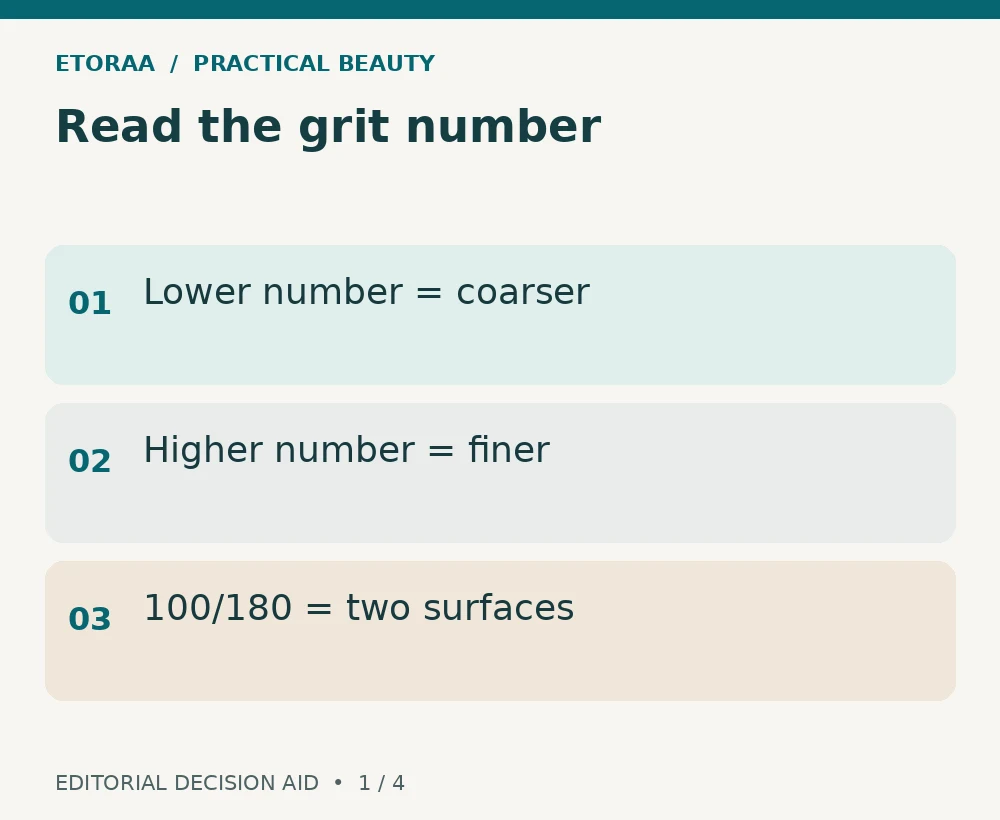
Nail file grit tells you how coarse an abrasive file is. A lower number means a coarser surface; a higher number means a finer one. For ordinary natural-nail edge shaping, look for a fine file intended for that use, rather than copying a coarse-file enhancement tutorial.
Etoraa editorial guide. Reviewed 28 October 2026. Original illustrations show generic objects; no comparative product testing was performed.
Read both sides of the label
A file marked 100/180 has two abrasive surfaces. It does not mean the number changes when you turn the file upside down. Identify which side you are using before touching the nail. If the markings have worn away and the surface feels uncertain, do not guess on a thin or damaged nail.
OPI’s professional hand-preparation guide uses a 240-grit file for shaping. Sally Beauty also places fine files in a different category from coarse files intended for acrylic extensions. These examples help explain the numbers. They do not mean that every task or every nail condition needs the same file.
Separate edge shaping from surface buffing
The free edge is the part that extends beyond the fingertip. Shaping that edge is different from abrading the top of the nail plate. A file sold for reducing artificial product should not become a general-purpose surface smoother for natural nails. More abrasion is not a shortcut to stronger nails.
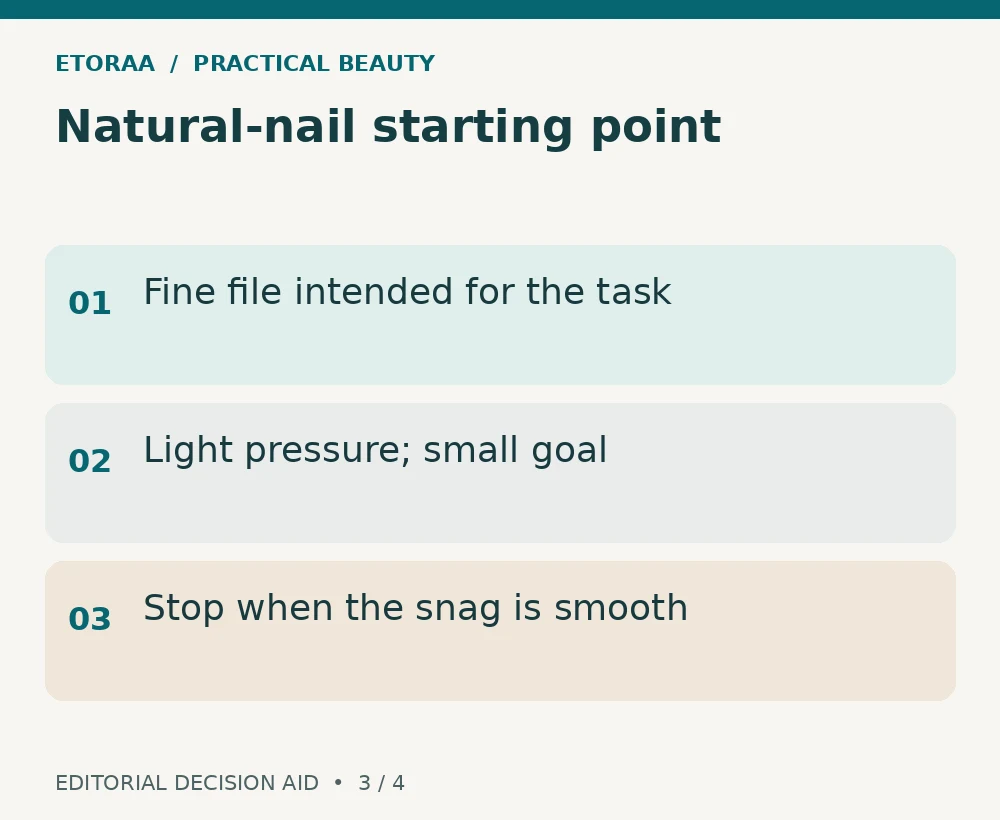
Choose a small goal, such as smoothing a snag that catches on clothing. Stop when the edge is comfortable. Do not continue simply because a salon video has several more preparation stages. Many professional preparation steps serve a particular enhancement system and do not belong in an ordinary at-home manicure.

Use nail file grit with a light routine
Check the file for damage and follow its intended use. Support your hand, work where you can see clearly, and remove only what you need. The American Academy of Dermatology recommends keeping nails shaped and free of snags with an emery board. It also advises leaving the cuticles alone rather than treating them as extra material to remove.
If a nail is painful, lifting, changing colour or repeatedly splitting, a different grit is not a diagnosis. Get appropriate professional advice. Avoid trying to erase a visible change by filing deeper into the plate.
Choose a file you can care for
A washable file and a disposable abrasive board need different care. Read the maker’s instructions before soaking, heating or spraying the tool. Store clean, dry tools where the abrasive surfaces will not scrape other items. Replace a worn file rather than pressing harder because it no longer feels effective.
Before shopping, note the task, the material and the grit on each side. Then compare the whole product rather than the lowest price alone. Our press-on nail guide covers a different decision: preparation and removal for an artificial nail system. Keep those instructions separate from routine shaping of your own nails.

Nail file grit: frequently asked questions
Is 100 grit finer than 240?
No. In this numbering system, 100 is coarser. Check the intended task as well as the number.
Does a higher number mean a better file?
No. It describes abrasiveness, not overall quality. The right tool matches the task.
Can I buff away every ridge?
Do not treat every ridge as a cosmetic defect to remove. Persistent or changing nail concerns deserve professional assessment.
Explore Etoraa’s beauty collection with a specific need and the product’s own directions in mind.
Sources and editorial scope
- OPI: hand preparation and 240-grit shaping. Accessed 28 October 2026.
- Sally Beauty: file categories. Accessed 28 October 2026.
- AAD: healthy nail tips. Accessed 28 October 2026.
The selection checklists and routine examples are Etoraa editorial suggestions. Manufacturer directions apply to named products; they do not establish a category-wide result. No paid endorsement or first-hand product trial is claimed.