Hair oil timing depends on the product’s job. A pre-wash oil is intended to be removed during washing; a finishing oil stays on the lengths in a small amount. Some products allow both. Read your formula’s directions before deciding, and do not assume oil replaces conditioner or treats a scalp problem.
By Etoraa editorial. Researched 5 November 2026. Editorial guidance; no personal product testing or medical review is claimed.
Hair oil timing: before and after do different jobs
Before-wash use fits a product designed for a rinse-out routine. After-wash use fits a leave-in finish intended for damp or dry hair. A bottle labelled hair oil may contain a blend of oils, silicones, fragrance and other ingredients. The name alone does not tell you the right amount or application point.
Start with the directions, including whether to use it on wet or dry hair. Our hair gloss versus hair oil guide explains the broader product categories. This guide answers the narrower question of when to use an oil you already have. You can choose neither timing if your routine already feels comfortable.

Use a pre-wash product without making removal harder
Follow the suggested placement and time, rather than assuming a longer treatment works better. Focus on the lengths unless scalp use is specifically suitable for the product and your needs. Keep it away from your eyes and avoid dripping oil onto a slippery shower surface.
For example, plan the step before a wash you already need. Apply the directed amount, then shampoo and condition as appropriate. If removal repeatedly needs harsh scrubbing or several extra washes, reconsider the amount or product. The AAD’s hair-care guidance supports cleansing the scalp and handling lengths gently. More oil is not a reason to abandon those habits.

Hair oil timing after washing: start with a little
Check whether your product is intended for damp hair, dry hair or both. Distribute the directed amount through the intended areas. Start conservatively, assess the feel and avoid repeatedly adding more because the first application is not immediately visible. Fine lengths and dense curls may need different amounts.
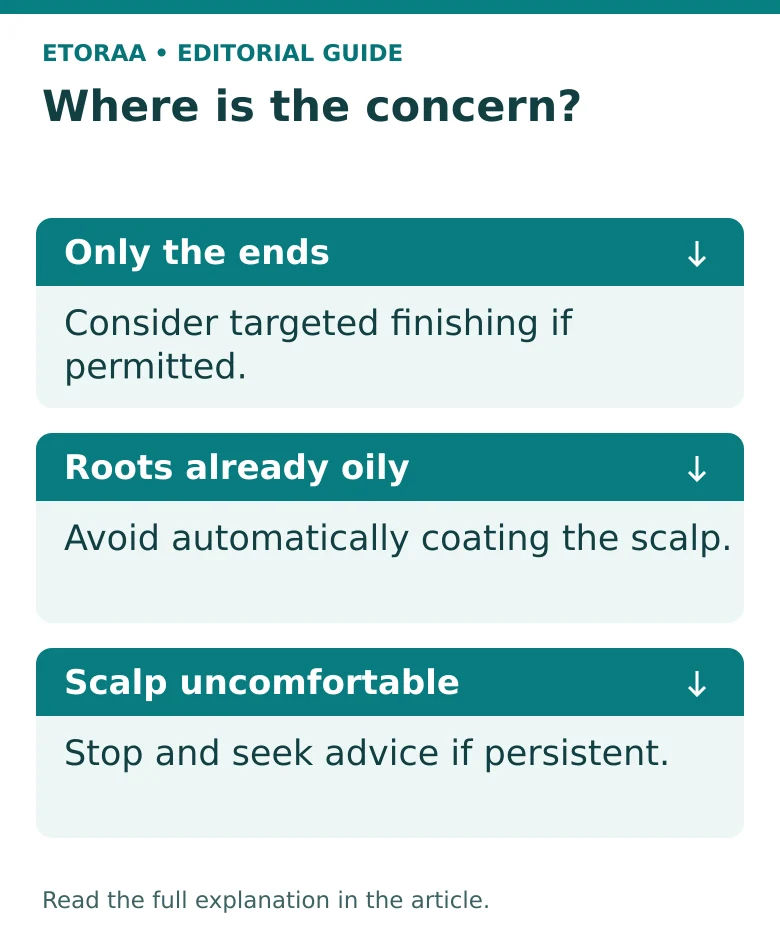
Imagine that your ends look untidy after drying but the roots already look oily. Adding product over the whole head is unlikely to answer that specific concern. A small finishing application to the ends may be the more relevant trial if the label allows it. Oil is optional cosmetic grooming. It cannot permanently mend a split end, and it is not automatically a heat protectant.
To compare hair oil timing sensibly, first choose the problem you are trying to solve. Is it a finish you want after styling, or a pre-wash step you want to try on the lengths? Keep the shampoo, conditioner and styling method stable while learning that one application. Record whether the oil makes detangling or washout harder as well as whether you like the look. If it creates another problem, reduce the complexity of the routine. You do not need to keep a step simply because a product description lists several possible uses.
Keep research claims specific
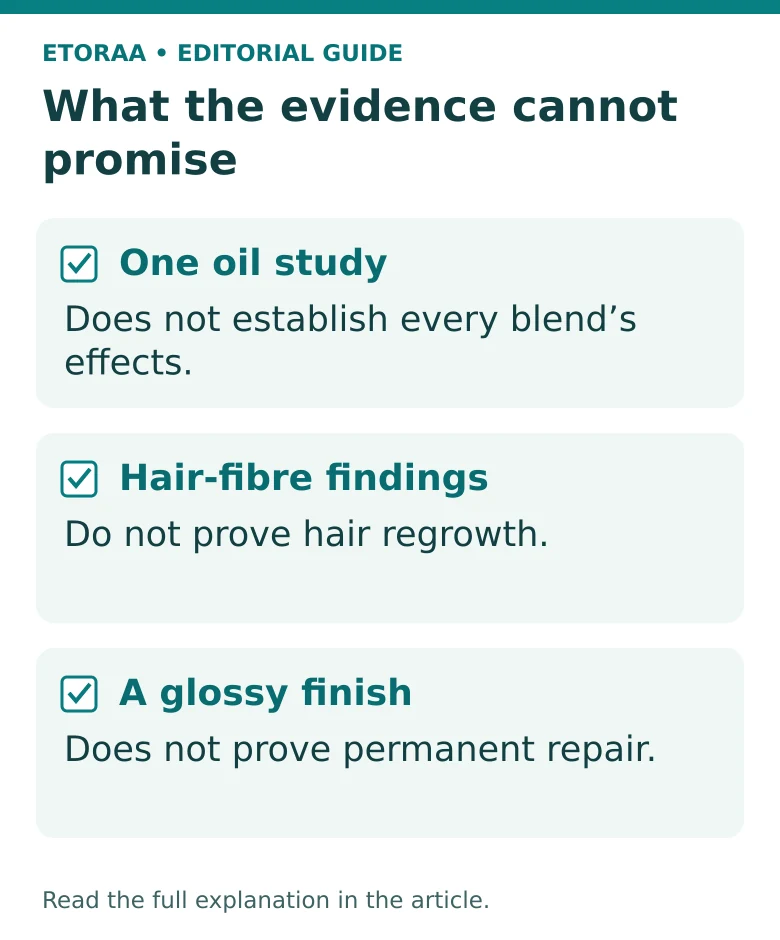
A 2003 study by Rele and Mohile compared coconut, mineral and sunflower oils and reported reduced hair protein loss with coconut oil in its pre- and post-wash experiments. It was hair-fibre research, not proof of hair regrowth or a guarantee for every finished oil blend. The authors were affiliated with an industry research department.
Use that evidence to set a boundary, not to rank every bottle. For an everyday decision, record when you applied your own product, how much you used and how easily it washed out. If your scalp becomes uncomfortable, stop the experiment. Persistent itching, flaking or shedding needs individual advice. A cosmetic finish and the management of a medical scalp condition are separate questions.
Frequently asked questions
Should I leave oil on overnight?
Only if that product’s directions support it and it suits your routine. Overnight use is not a universal requirement, and more time does not establish a better result.
Can I use one oil before and after washing?
Some formulas permit both. Check the instructions and use each method for a clear purpose. Avoid doubling the amount simply because two timings are possible.
Sources and update notes
- AAD: healthy hair care. Date not displayed. Accessed 5 November 2026.
- Rele and Mohile: oil and hair damage. March–April 2003; abstract retrieved; full paper not reviewed. Accessed 5 November 2026.
Featured image: AI-generated editorial illustration; generic props, not a product photograph or test. Body graphics are original editorial decision aids, not measured product results.