
A hair diffuser spreads a dryer’s airflow across a wider area. Start with an attachment approved for your dryer, the lowest heat setting and gentle airflow. Dry in sections with limited handling, then adjust the method to your curl pattern and preferred finish.
By Etoraa editorial. These are source-based styling suggestions, not results from testing a dryer.
Check the tool before the technique
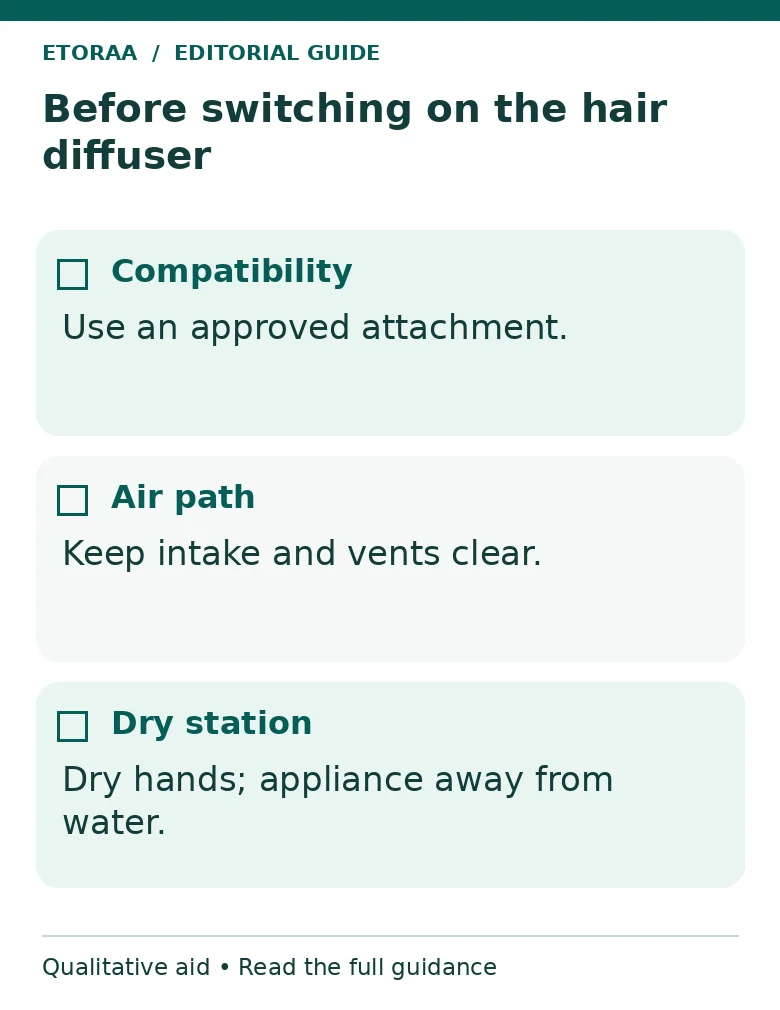
A bowl that seems to fit is not necessarily compatible. Look up the exact dryer model and its approved attachments. Check how to attach, remove and clean the diffuser, including whether it must cool first. Keep vents unobstructed and follow the appliance’s electrical safety instructions.
Prepare your station on a dry surface away from water. Handle the dryer with dry hands. Do not balance a running appliance on a towel or use it where it could fall into a basin. These checks belong before any styling experiment.
Prepare curls without adding a complicated routine
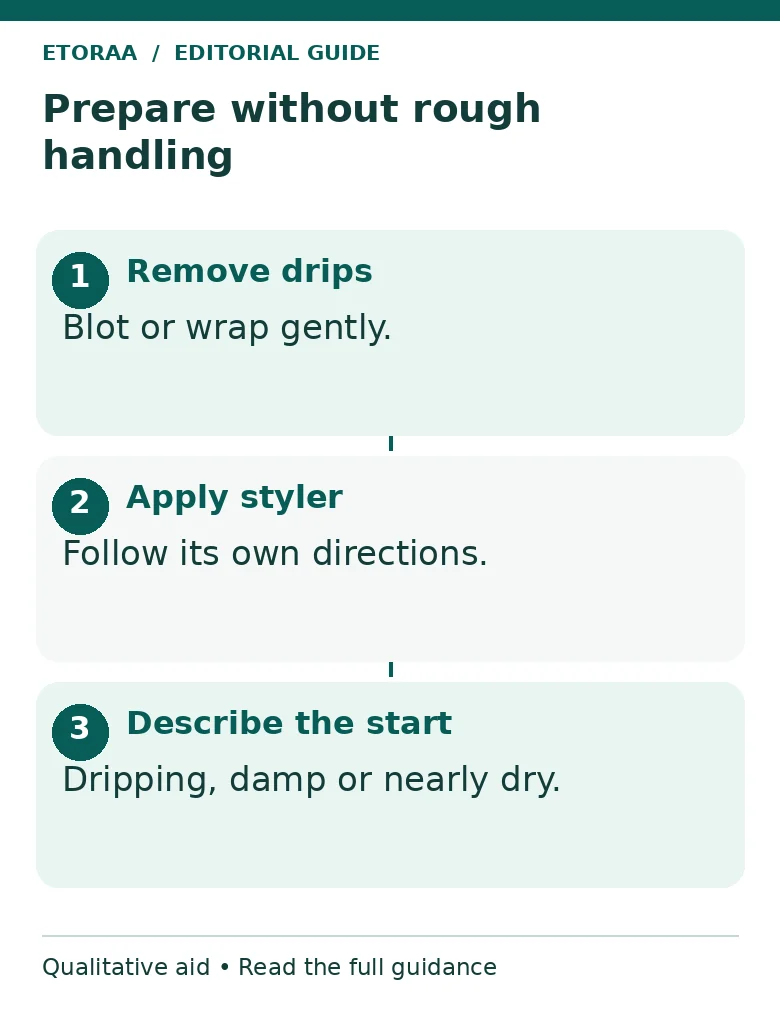
After washing, gently remove dripping water without rough rubbing. Then use the styling products you already tolerate, following their directions. A diffuser does not require a particular branded cream, mousse or gel. If you are choosing a styler, our mousse-versus-gel comparison explains their different styling roles.
Avoid guessing a required percentage of dryness. Hair density, length, the dryer and your available time all change the starting point. Instead, note whether your hair is still dripping, damp or nearly dry. That gives you a repeatable description without pretending you measured water content.
Try hovering before cupping
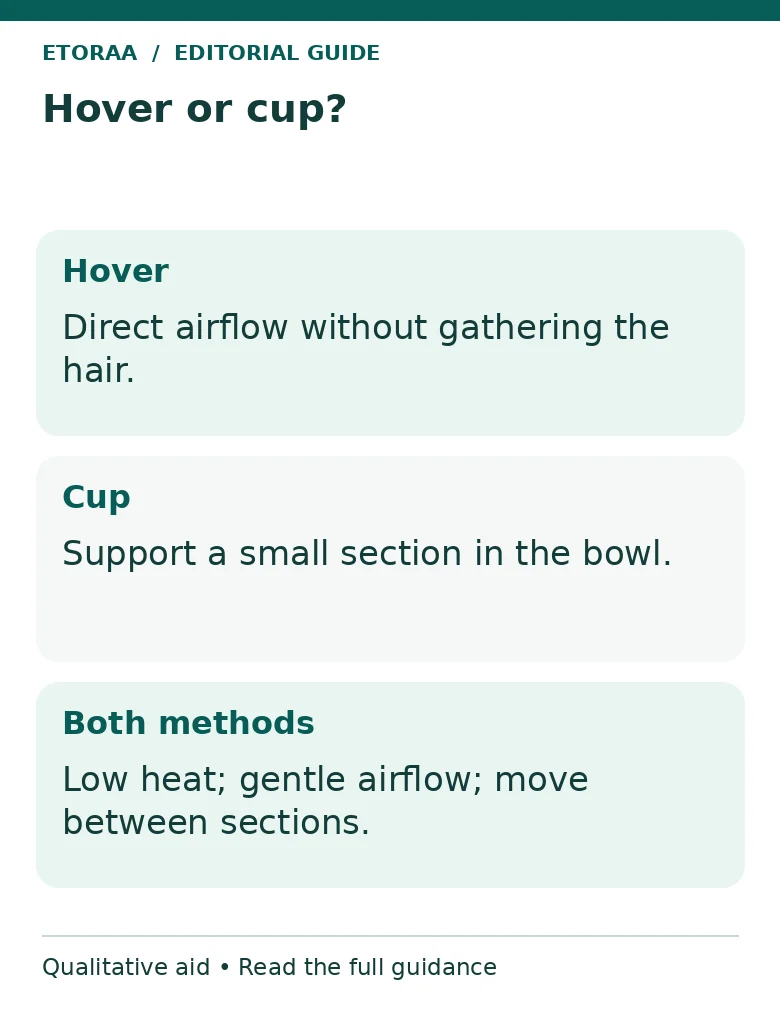
Hovering means directing the diffuser towards a section without gathering the hair in its bowl. Start there if cupping feels awkward or disturbs the shape. Move between sections rather than concentrating heat on one spot.
Cupping means resting a manageable section in the bowl and bringing it towards the head without pressing hot parts against skin. Switch the dryer off while repositioning if that gives you better control. Do not force long hair into a small bowl or let it catch near the intake.
L’Oréal Paris describes diffuser styling as part of a curl routine, while Blow and Barrel discusses hovering and cupping. These are techniques to try, not a promise of a particular curl result. See the manufacturer’s styling guide and the practical salon guide.
Keep heat and handling modest
The American Academy of Dermatology advises letting hair air dry when possible and using the lowest heat setting when blow-drying. A hair diffuser does not remove the possibility of heat damage. Read the AAD’s hair-damage guidance.
If your scalp feels hot or uncomfortable, stop and reassess the setting, distance and time in one place. Do not endure discomfort to finish faster. You can also air dry partway and diffuse only when it suits your schedule.
Avoid constantly separating or touching curls as they dry. Once finished, allow the hair to cool before deciding whether it needs gentle fluffing. A firm styling-product cast is different from hair still feeling wet; follow your styler’s finishing guidance.

Use a small styling record
For your first attempt, record attachment, heat, airflow, starting dampness and technique. Next time, change only one variable. For example, compare hovering with a short period of cupping while keeping the styler and dryer settings the same.
Judge the result against a practical goal: comfortable drying, a finish you like and a routine you can repeat. Do not treat a single attempt as proof that your hair “cannot” be diffused. Our towel-drying guide can help simplify the preparation stage.
Frequently asked questions
Must I dry upside down?
No. Choose a comfortable, stable position. You can work upright and tilt slightly to reach sections without straining your neck.
Will a diffuser prevent every frizzy strand?
No. Your hair, products, handling and conditions all matter. A softer or less uniform finish can also be a preference, rather than a fault.
Is maximum heat necessary for thick hair?
No. More hair may take longer, but that does not cancel the appliance instructions or professional advice to keep heat low.
Sources and scope
Sources accessed 30 October 2026: AAD hair-damage guidance; L’Oréal Paris diffuser guide, date not displayed; Blow and Barrel, 11 October 2026. This is an evergreen styling guide. Images are original editorial illustrations and qualitative aids, not evidence of tested curl performance.